




 August 14, 2026
 Simon Sparacca
Baudouin to Explore the Impact of AI Workloads on Backup Power at DCD Connect London 2026
Baudouin will participate in DCD Connect London 2026. Taking place on 16–17 September 2026 at the Business Design Centre in London.
Bringing together more than 5,000 senior professionals, over 280 expert speakers and more than 150 technology providers. This event provides an important platform for the European data centre industry. Also, to discuss the challenges involved in designing, building and operating infrastructure for the AI era.
Throughout the two-day event, the Baudouin team will present its high-power generator set solutions for mission-critical applications and contribute to the technical programme with a dedicated session examining whether conventional backup power systems can respond effectively to the rapidly changing electrical demands created by artificial intelligence.
Can backup generators keep pace with AI workloads?
Unlike more traditional IT environments, large clusters of GPUs can produce rapid and synchronised variations in electrical demand. When thousands of processors move through the same computational phases simultaneously, the resulting load profile can change significantly within a very short period.
These variations create new considerations across the complete electrical architecture of a data centre. Backup generators must do more than reach their rated output. They must respond dynamically, maintain frequency and voltage stability, and operate reliably when exposed to repeated and demanding load variations.
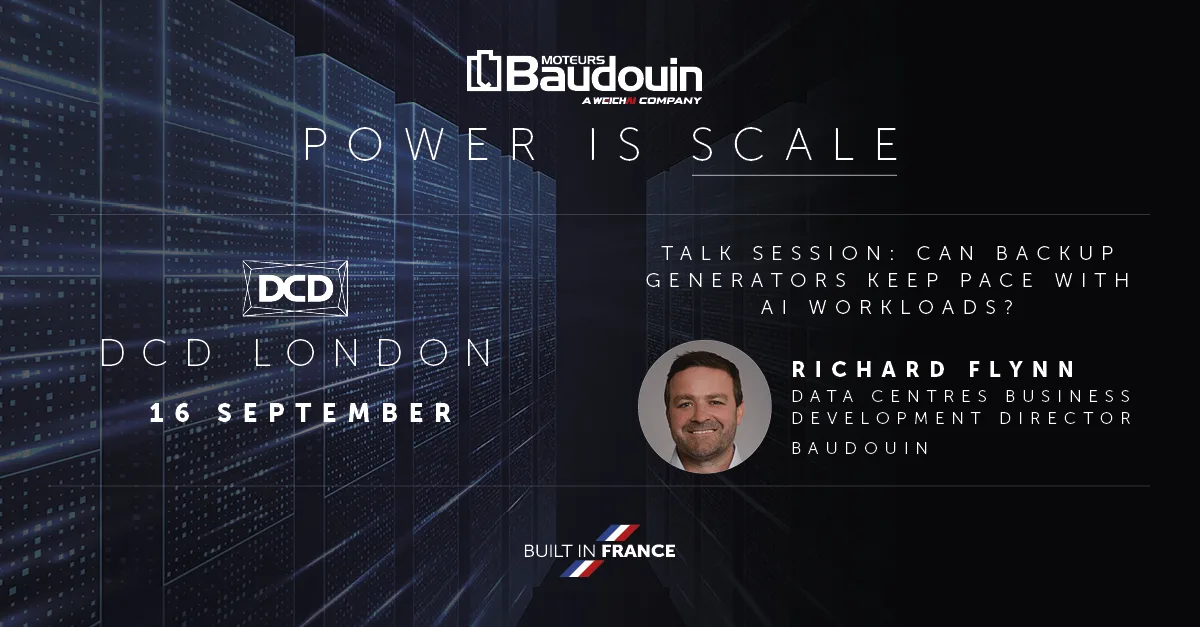
During DCD Connect London, Richard Flynn from Baudouin will present a dedicated technical session entitled:
Can backup generators keep pace with AI workloads?
The presentation will explore how synchronised GPU load variations are challenging traditional power-system assumptions. And how it changes the way backup generation should be specified, tested and integrated.
Drawing on full-scale testing of a 2.4 MW backup generator, Richard will discuss what AI workload profiles reveal about:
- – Dynamic engine and generator response
- – Frequency and voltage stability
- – Behaviour during rapid load increases and reductions
- – Repeated transient operating conditions
- – Mechanical and electrical durability over time
The session will also identify key considerations for data centre operators, consultants, EPC contractors and designers responsible for developing resilient power systems for AI infrastructure.
Rather than approaching AI purely as a question of additional capacity, the talk will examine the importance of understanding the complete load profile.
A generator may have sufficient nominal power for an installation. But its ability to manage repeated, synchronised and rapidly changing demand must also be considered during system design.
Richard Flynn specialises in critical power, data centres and distributed energy. Combining commercial experience with a detailed understanding of engine technologies and resilient power systems, he works closely with customers, consultants and industry partners to develop scalable solutions for mission-critical facilities.
The Baudouin session is currently listed on the event agenda as an open DCD Talk on the Talks Stage at 9:00 a.m. on 17 September
High-power generator sets for data centre applications
Alongside the technical presentation, visitors will be able to meet the Baudouin team and learn more about the company’s generator set range for data centre and mission-critical applications.
Baudouin’s M33, M55 and M61 platforms cover a broad range of high-power requirements, supporting projects from regional facilities to large-scale hyperscale and AI infrastructure.
At the upper end of the portfolio, the M61 platform delivers up to 6250 kVA per generator set. It provides an option for projects requiring greater power per unit. This can help system designers meet high capacity requirements while managing the number of generator sets, installation footprint and overall plant architecture.
Depending on the selected platform and configuration, the Baudouin data centre range also offers:
- – Uptime Institute pre-approved power ratings
- – ISO 8528-5 G3 load-acceptance performance
- – Compatibility with HVO fuel
- – Lead times below six months on selected configurations
These capabilities support the central requirements of modern data centre projects: availability, dynamic performance, scalability and project delivery.
As grid-connection delays and equipment supply constraints continue to influence development schedules, the ability to source and integrate critical power equipment within the required timeframe has become an increasingly important part of infrastructure planning.
However, capacity and delivery time alone are not sufficient. Generator sets must be selected as part of the complete electrical system. And, taking into consideration the UPS architecture, load sequence, controls, redundancy strategy, cooling equipment and expected workload behaviour.
The arrival of AI makes this system-level approach even more important. By combining suitable generator sizing with realistic load analysis and full-scale validation, operators can reduce uncertainty and better understand how their backup power infrastructure will behave during a real utility failure.
Meet Baudouin at DCD Connect London 2026
DCD Connect London brings together operators, hyperscalers, engineering consultants, contractors, technology providers and investors from across the European digital infrastructure ecosystem.
The 2026 edition will be held alongside the Xcelerated Compute Show and the DCD Investment Forum, connecting discussions around data centre design and operations with the compute technologies, investment strategies and infrastructure requirements driving AI development.